
Key Takeaways
- Rank upgrades by what you feel on the ground per dollar spent, and protection comes first because a broken lever ends a ride on the spot.
- Tyres change more about how a bike behaves than any other bolt-on part, and our trail machines use a 140 rear specification for grip.
- Setup ranks above parts, and the first question is whether your fork adjusts at all, because our PH05B and PH10L run non-adjustable forks.
- Fork travel across seven of our models runs from 735 mm to 940 mm, so suspension parts rarely interchange between models.
- Engine and exhaust work comes last, because the felt change is the smallest in the whole list and the cost is rarely the smallest.
Most upgrade advice arrives sorted by price, which is the one order that tells a rider nothing about what to buy first. The order that works is by the change a rider feels on the ground for each dollar spent, and that order is consistent enough to write down. Protection sits at the top because it prevents a ride from ending, tyres come next because they touch every input the rider makes, and setup comes third because adjustment is free wherever the fork adjusts. Engine and exhaust work sits near the bottom, which disappoints riders who start their list there. We measured fork travel, kerb mass and engine output across our own range, and the figures below come from those measurements rather than from a catalogue.
One rule applies to every item below. Buy for the ground you ride on, because a part that transforms a machine on one surface changes nothing on another.
Rank by Effect, Not Price
Effect per dollar is the only ranking that survives a full season, because it measures the result rather than the reputation of a part. An exhaust system costs more than a set of tyres and changes less about how the machine behaves, while a fork adjustment costs nothing and changes more than either. In addition, the cheapest items on the list usually deliver the largest gains, which is the opposite of how most riders expect a budget to work. Therefore, the order below is not a suggestion about quality and it is a statement about returns. In our experience, riders who follow it end up happier with the machine they already own rather than buying a second one. For example, a rider who spends the first budget on tyres and setup will feel a larger difference in the first month than one who spends twice as much on engine parts.
The ranking also protects riders from a common problem of timing, which is spending on performance before the machine is reliable. A rider who fits an exhaust and then loses a weekend to a stretched chain has spent money in the wrong order, whatever the quality of the exhaust. Consequently, reliability items should be finished before performance items are considered at all. In our experience, that single rule prevents more wasted money than any buying guide can, because it addresses the order of spending rather than the choice of products. Similarly, a machine that is reliable is worth more than a machine that is fast and stops working.
Two constraints belong before any purchase, because a part that does not fit is worse than no part. Fork travel across our seven models runs from 735 mm to 940 mm, so suspension components rarely interchange between models in the same range. In addition, our PH05B and PH10L run non-adjustable forks, which means the setup route is closed on those machines and the parts route is the only option. Therefore, check the specification of your own model before ordering anything, and treat a listing that omits the model as a reason to keep looking.
| Priority | Upgrade | Why it earns the spot |
|---|---|---|
| 1 | Handguards, skid plate, lever guards | Prevents the failures that end a ride immediately |
| 2 | Tyres matched to your surface | The largest change in grip of any bolt-on part |
| 3 | Fork and shock setup | Free where the fork adjusts, and it changes everything |
| 4 | Chain, sprockets and gearing | Changes how the engine reaches the ground |
| 5 | Engine and exhaust | Smallest felt change per dollar spent |
Protection First
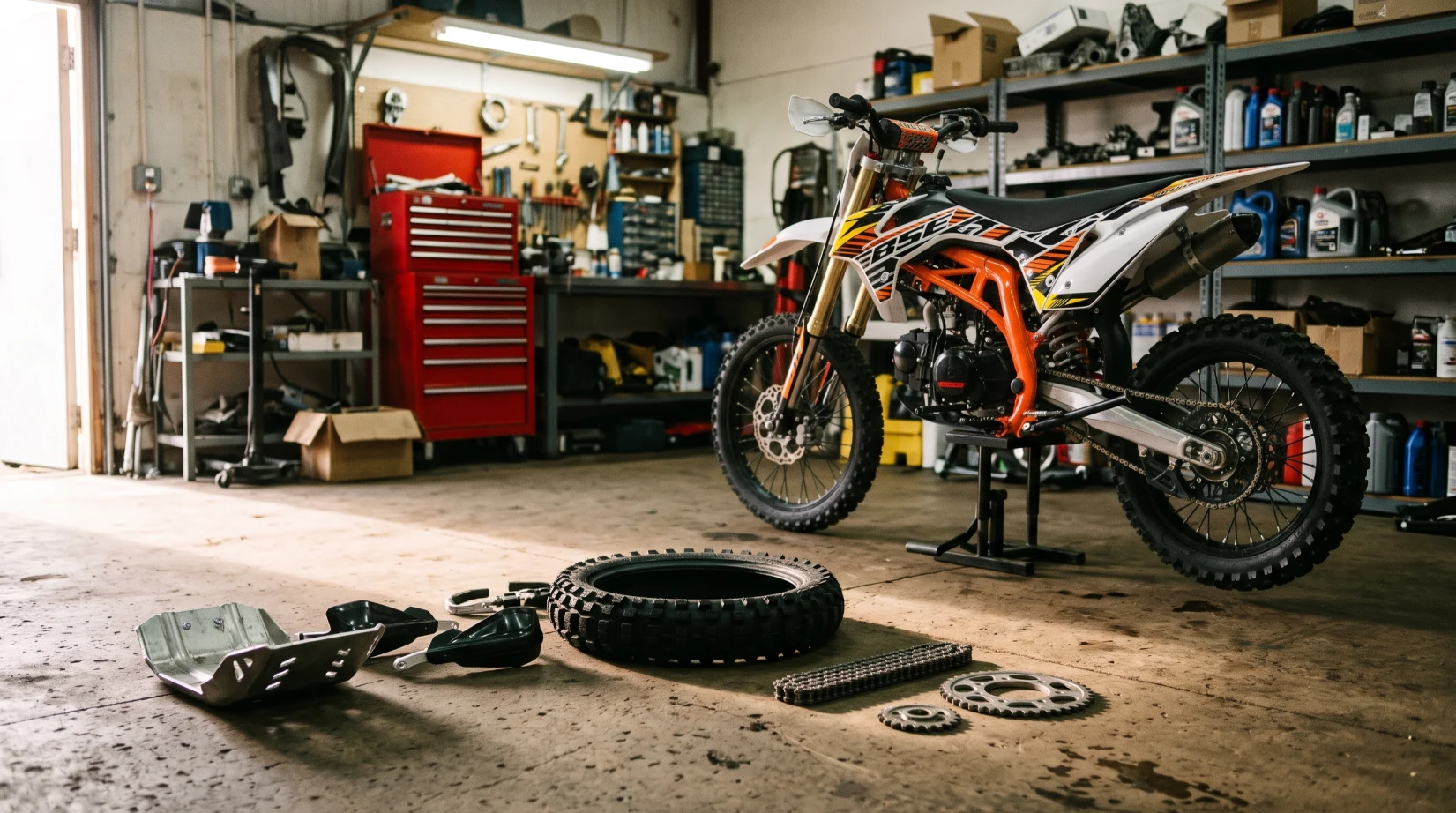
Protection comes first because the parts it protects are the parts that end a ride when they fail, and a lever that breaks twenty kilometres from the ute ruins the day. Handguards keep branches away from the levers and keep the levers off the ground when the bike falls, which is the more frequent event by a wide margin. A skid plate protects the underside of the engine and the frame rails from rocks and logs, and a machine used on rocky ground without one will eventually pay for the omission. Therefore, protection is the cheapest way to protect the purchase you have already made.
Lever guards deserve a place alongside handguards for riders who ride in company, because a dropped bike in a group is a common event. A guard turns one of the most likely breakages into a non-event, and a spare lever or two in the toolbox closes the remaining gap. Consequently, the protection budget is best spent before the machine has a chance to demonstrate the cost of going without it. In our experience, riders who fit protection in the first month spend less on repairs across their first year than riders who fit it later. Consequently, the cheapest part on the list is usually the one that saves the most expensive repair.
Gear belongs in this section even though it does not bolt to the bike, because it protects the rider rather than the machine. The national product safety regulator advises riders to wear a helmet and protective equipment, and riding boots protect the ankle and lower leg from the bike itself when it falls at low speed. Therefore, the cheapest protection in the entire list is the protection a rider wears. Admittedly, boots feel awkward for the first few rides and the awkwardness disappears within a week, which is a shorter period than most riders expect.
Tyres: The Biggest Change
Tyres produce the largest change of any bolt-on part, because every input a rider makes reaches the ground through them. Grip affects acceleration, braking and cornering at the same time, and no other part on this list touches all three. Our trail machines use a 140 rear specification because a wider contact patch keeps drive going to the ground on loose surfaces. Consequently, the first question is not which tyre is best in the abstract but which surface you ride most often, because the answer changes completely between mud, hardpack and rock.
We also fit small-bike tyres as original equipment rather than leaving riders to choose, because a tyre that fails in service costs more than it saves. That is a commercial judgement rather than a measured result, and we label it as one. In other words, the tyre decision is one place where the risk of a bad purchase is genuinely low, which makes it a better use of money than parts with a smaller effect. For example, a rider who changes from a worn trail tyre to a fresh one for the same surface feels a bigger difference than a rider who changes an exhaust.
Tyre pressure is the free half of the decision and the half riders neglect most often. We are not going to publish a pressure in psi, because the correct figure depends on the tyre, the terrain and the temperature, and the number in your own machine’s specification sheet beats a number from an article. For surface-by-surface starting points, see our tyre pressure guide. What we will say is that a pressure suited to hardpack rarely suits loose sand, so a rider who changes surfaces should expect to change pressures as well. Admittedly that is more work than leaving it alone, and it remains the cheapest handling improvement available.
Suspension Setup
Setup ranks above parts because setup costs nothing wherever the fork adjusts, and most riders have never touched the adjusters on the machine they own. A bike delivered with settings for a different rider will still work, and it will work worse than it should at every bump. Therefore, the first question is whether your fork adjusts at all, and the answer separates the two routes cleanly. Among our models, the PH05B and PH10L run non-adjustable forks, while the PH15C, X8 and T300 are adjustable.
Where the fork adjusts, three settings carry most of the difference, and none of them needs a workshop. Compression damping controls how the fork behaves as it absorbs an impact, rebound controls how quickly it returns to position, and spring preload sets how much of the travel you use at rest. We are not going to publish a sag measurement in millimetres or a factory setting calibrated to an average rider, because we have no verified figures for either and the claims appear in marketing copy rather than in engineering documents. Work from your machine’s own manual and from how the bike behaves on the ground you ride.
The practical approach is to ride the same short loop before and after each change and to change one thing at a time. A rider who alters three settings together cannot tell which one worked, and a rider who changes one setting learns the machine quickly. Similarly, write down what you changed, because a fork that feels wrong after four adjustments is easier to return to a known state than to diagnose. In our experience, riders who keep a note of their settings end up with a machine they understand and riders who do not end up paying someone else to guess. Consequently, a notebook is the cheapest suspension tool available, and it costs less than a single clicker adjustment made twice.
If your fork does not adjust, the honest advice is to accept it and spend the money on tyres instead. Upgrading a non-adjustable fork is a project rather than an afternoon, and the same money usually delivers more on the ground elsewhere. That is not a criticism of the machine, because those models are built to a price that makes them worth owning.
Chain and Gearing
Chain and gearing change how the engine reaches the ground, which makes them more interesting than their cost suggests. Final drive ratios work like the choice between two gearboxes, and a shorter ratio gives stronger acceleration while a longer one spreads the same engine over more speed. Our race-oriented combination runs 520-13/49 and our trail and general-use combination runs 520-13/45, with 420-15/41 and 420-14/39 on the smaller platforms. Therefore, a rider who wants a different character from an existing engine can often get it from two sprockets.
Chain maintenance is the other half of this section, and it is the cost item owners underestimate most often. Chain stretch drives frequent adjustment on machines used for rental and farm work, which makes the drivetrain a recurring expense rather than a one-off purchase. Consequently, a rider who checks tension, lubricates the chain and replaces worn sprockets together spends less over a season than one who replaces a chain and leaves the sprockets on. We are not going to publish a tension in millimetres, because the correct figure varies by model and your own specification sheet carries it.
Two habits make the difference and both are free. Clean and lubricate the chain after wet or dusty rides rather than on a calendar, because conditions drive wear more than time does. Then check the alignment of the rear wheel whenever you adjust the chain, because a misaligned wheel wears the chain faster and makes the bike handle oddly. In our experience, those two habits account for most of the drivetrain life a rider gets from a machine.
Engine and Exhaust Last
Engine and exhaust work sits last because the felt change per dollar is the smallest on the list, and because the gains riders anticipate rarely arrive. An exhaust changes weight, sound and a modest amount of output, and it changes them at a price that would cover tyres and a full setup. Consequently, a rider who buys the exhaust first usually has a louder machine rather than a faster one. We are not going to quote prices, because we have no sourced figures, and the comparison holds at most price points anyway.
Engine work itself deserves more respect than riders give it, because output varies enormously within a single capacity. Our 250cc machines run from 12 kW to 19 kW, while an older 223cc design that the industry has used for more than twenty years produces only 12 to 13 kW. In other words, capacity tells you very little about output, and a rider who wants more power may be riding a detuned version of an engine that already exists in stronger form. Therefore, check the output figure for the specific model before assuming that a larger capacity is the answer.
Heat management is the last point, and it matters most on air-cooled machines used at low speed. Our approach is to increase the cooling fin area and to drill the cylinder wall so that airflow forms a vortex around the barrel, which improves cooling without adding a radiator. In our experience, riders who work air-cooled machines hard in low gears gain the most from that design, and riders who ride fast open ground notice it least. Either way, it is an engineering decision rather than an upgrade a rider can bolt on afterwards.
What We Fit as Standard
We fit several components at the factory rather than leaving them to the aftermarket, and the reason is that these are the parts where a cheaper alternative costs more over a season. Our machines use NGK spark plugs, an FCC clutch assembly, and 7-series aluminium rims with CNC hubs and stainless spokes. Each of those choices comes from our own engineering evaluation rather than from an independent test, and each one addresses a failure pattern we have seen in service. Therefore, the correct replacement for one of those parts is generally the same part rather than a substitute.
The wheel specification deserves its own sentence, because it is the change most riders notice without knowing why. A 7-series aluminium rim with a CNC hub centre and stainless spokes reduces unsprung mass, and reducing mass at the wheel changes handling more than an equivalent saving anywhere else on the machine. That is why the same logic appears across our platforms rather than in one product line only. In addition, a stronger spoke survives the impact that trail riding produces regularly, so the wheel change is a reliability improvement as well as a handling one.
Service parts are worth separating from upgrades, and the distinction saves money. A worn chain, a fouled plug, a tired clutch and a flat tyre are not upgrades, and replacing them with more expensive versions than the originals rarely returns anything. Consequently, the highest-value decision for most owners is to keep the specified parts in good condition rather than to fit different ones. Our guide to choosing a machine that fits you and our guide to licensing in Australia cover the decisions that come before the upgrade list.
Frequently Asked Questions
What should I upgrade first on a dirt bike?
Protection, which means handguards, a skid plate and lever guards. Those parts prevent the failures that end a ride immediately and cost less than the components they protect. Tyres come second, because they change grip more than anything else bolted to the machine. Engine and exhaust work sit at the bottom of the list (BSE Motor, 2026).
Is an aftermarket exhaust worth it?
It adds a modest amount of output and a larger change in weight and sound, which makes it poor value compared with tyres or a suspension setup. We do not quote prices because we have no sourced figures, and the comparison holds at most price points. Spend the same money on tyres and setup first, then reconsider.
How do I know if my fork is adjustable?
Check the model. Our PH05B and PH10L run non-adjustable forks, while the PH15C, X8 and T300 are adjustable. Fork travel across our seven models ranges from 735 mm to 940 mm. If your fork adjusts, your manual will identify the compression, rebound and preload adjusters (Product Safety Australia, 2026).
What tyre pressure should I run off road?
We do not publish a pressure in psi, because the right figure depends on the tyre, the terrain and the temperature. Use the figure in your own model’s specification sheet as a starting point and adjust for the surface. Riders who move between hardpack and loose ground should expect to change pressures.
Which give more grip, wider or narrower tyres?
Wider is better on loose ground, where a larger contact patch improves drive, and narrower is better on a groomed surface where a wide tyre packs up with mud. Our trail machines use a 140 rear specification for grip. The right answer depends on your surface rather than on the size of the bike.
Conclusion
Three ideas carry the whole list. Rank by the change you feel per dollar, which puts protection first and engine work last. Check whether your fork adjusts, because adjustment is free where it exists and the setup route beats the parts route. Then choose tyres for your surface, since they touch braking, acceleration and cornering at the same time.
Your next steps:
- Fit handguards, a skid plate and lever guards before anything else.
- Check whether your fork is adjustable and read the manual if it is.
- Choose tyres for the surface you ride most often.
- Keep the factory-specified parts in good condition before considering substitutes.
Continue Learning
- Choosing a dirt bike by inseamWhy height is a poor guide to fit.
- Dirt bike licence: R-E class explainedClasses, LAMS and age minimums.
- Recreational registration state by stateQueensland, Victoria, WA and NSW.
- Browse our dirt bike rangeTrail, race and youth models.
Specs for the models this guide talks about
Figures below are taken from our own product documentation (BSE Motor, 2026).
BSE PH05B — 125cc pit bike
- Seat height 790 mm
- Kerb mass 75 kg
- Wheelbase 1,220 mm
- 6.5 kW at 7,000 rpm, four gears
BSE PH12A — 150cc enduro
- Seat height 860 mm
- Kerb mass 89 kg
- Ground clearance 300 mm
- 7.5 kW at 8,500 rpm, five gears
See what we fit as standard
NGK plugs, FCC clutch assemblies, 7-series rims with CNC hubs, and stainless spokes.
View dirt bikes →References
- Product Safety Australia, ACCC. Quad bikes mandatory standard. Accessed September 2026 (Product Safety Australia, 2026).
Fork travel, engine output, gearing, kerb mass and tyre specification figures in this article were measured by our own engineering team on our own machines, so they are not independent laboratory results (BSE Motor, 2026). Component specifications come from our own factory documentation (BSE Motor, 2026). This article was written by Mojo and reviewed by our engineering team. You can read more about us on the site, or contact our team with questions about a specific model.