
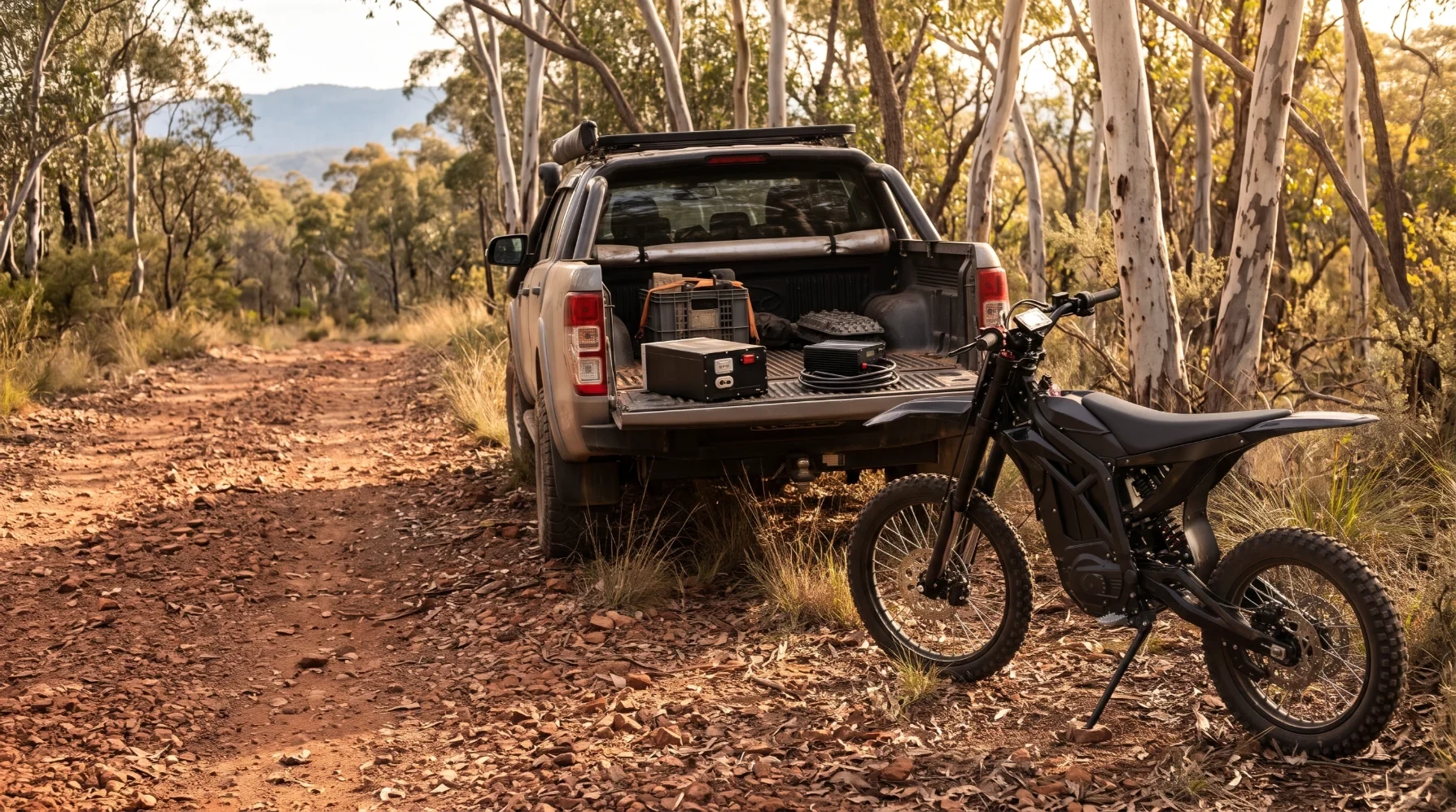
Key Takeaways
- An electric dirt bike sits inside Australia’s registration and licensing framework, so riding one on a road network needs the same permissions as any other motorcycle.
- Our factory test riders measured a maximum range of 128 km, a top speed of 100 km/h against published figures of 90 km/h (E60) and 105 km/h (E72), and a 50 degree climbing capability.
- Our electric dirt bikes weigh 68 to 72 kg against 100 to 120 kg for a comparable petrol machine, and that gap changes what a rider can do alone.
- Swappable packs come in 30 and 40 Ah, and a 60V platform with Samsung 21700 cells keeps the pack small enough to remove.
- Charging takes 3 to 6 hours depending on the pack, so a spare pack changes a riding day more than a faster charger does.
Electric dirt bikes attract a specific misunderstanding in Australia, which is that the electric drivetrain places the machine in a different legal category from a petrol one. It does not. A machine with an electric motor that is capable of propelling itself at road speeds is a motorcycle for the purposes of the road rules, which means it needs registration, compulsory third party insurance and a licensed rider before it goes on a road network. The confusion arises because electric bicycles sit in a separate, less regulated category, and the two are not the same product despite both having a motor and two wheels. Consequently, the first question for an Australian buyer is not which machine but which framework the machine falls into.
We build electric dirt bikes and our factory test riders measure them on the same test loop every time, so this guide uses our own figures rather than a catalogue. Every measurement below is a factory test result rather than an independent laboratory result.
Do the Same Rules Apply?
The road rules apply to an electric motorcycle in the same way they apply to a petrol one, because the rules attach to capability rather than to the drivetrain. If a machine can travel at road speeds under its own power, it is a motorcycle, and the registration, insurance and licensing requirements follow from that classification. Therefore, a rider who intends to use an electric dirt bike on a road needs a registered machine and a current licence. In our experience, riders who assume electric machines sit outside the framework are the ones most often caught out by it.
Electric bicycles occupy a genuinely separate category, and the distinction rests on power output, speed capability and whether the motor assists a pedal drive rather than driving the machine alone. Machines that do not meet those requirements cannot be used on roads or related areas, which is why a compliant e-bike and a non-compliant one look similar and behave very differently. Consequently, a rider comparing an electric dirt bike with an electric bicycle is comparing two regulatory categories rather than two products. In our experience, that distinction resolves most of the confusion buyers bring to a dealership.
Off-road use follows the state framework that applies to any dirt bike, and the electric drivetrain does not change it. Private land with the owner’s consent sits outside the registration requirement in Western Australia, which is the clearest statement of the principle in Australian law, and public land generally requires a licence and often a registration as well. Therefore, an electric machine and a petrol machine on the same property face identical requirements. Our guides to recreational registration and to licence classes cover the detail.
What 60V Actually Means
Voltage describes the electrical platform a machine carries rather than the speed it will reach, and that distinction matters when comparing two electric bikes. A higher-voltage platform can spin a motor further before the controller runs out of headroom, and it delivers the same power at lower current, which reduces heat in the wiring and the controller. However, none of that fixes a machine’s top speed on its own, because gearing and weight matter as much as the electrical side. Therefore, a rider comparing a 60V machine with a 72V machine should compare the complete specification rather than the voltage alone.
Our 60V platform uses Samsung 21700 cells, and the cell format is worth a sentence because it affects the pack rather than the bike. A 21700 cell is wider and taller than an 18650 cell, so each one holds more energy, which means fewer cells are needed for the same capacity. Consequently, the pack needs fewer interconnections and occupies less space, which is what makes it practical to remove and swap. In our experience, riders notice the pack size before they notice any other electrical specification, because a pack you can lift is a pack you will actually carry.
Our packs come in 30 and 40 Ah versions, and the choice matters more than the voltage label because it decides how long a session lasts. A rider who does two-hour sessions needs one pack and an overnight charge, while a rider who travels for a full day gets more value from a second pack than from any other change. Therefore, match the capacity to your riding rather than buying the largest option available. That decision is free to make and expensive to correct afterwards.
Measured Range and Weight
Our factory test riders measured a maximum range of 128 km on our test loop, a top speed of 100 km/h, against published figures of 90 km/h for the E60 and 105 km/h for the E72, and a climbing capability of 50 degrees. They also measured torque at 250 to 260 N·m at the motor output shaft. Those figures come from our own riders on our own loop rather than from an independent laboratory, and we label them that way because the distinction matters. Consequently, treat the range figure as a best case under favourable conditions rather than as a promise for every ride.
Weight is the measurement with the largest practical effect, and the gap against petrol is substantial. Our electric dirt bikes weigh 68 to 72 kg, while a comparable petrol trail bike runs 100 to 120 kg. That difference shows up in ordinary moments rather than on a stopwatch, because lifting a 65 kg machine back onto its wheels is a task one tired person can manage while lifting 115 kg is a struggle. Therefore, the weight figure changes where a rider feels safe, not only how fast they go. Our guide to matching a machine to your inseam covers the fit side of the same decision.
| Measurement | Figure | Source |
|---|---|---|
| Maximum range | 128 km | Measured by our factory test riders |
| Top speed | 100 km/h measured; 90 km/h (E60) and 105 km/h (E72) published | Measured by our factory test riders |
| Climbing capability | 50 degrees | Measured by our factory test riders |
| Torque at the motor shaft | 250 to 260 N·m | Measured by our factory test riders |
| Kerb mass | 68 to 72 kg (petrol: 100 to 120 kg) | Our own measurements |
| Swappable pack options | 30 and 40 Ah | Our own product documentation |
The published top speed is lower than the measured figure, and that gap is deliberate rather than an error. We publish a conservative figure because top speed depends on rider weight, surface and gradient, and a published number becomes a promise in the buyer’s mind regardless of how it was obtained. Consequently, the measured figure tells you what the machine can do and the published figure tells you what we are prepared to stand behind. In our experience, riders would rather have an honest lower number than an impressive one that arrives only downhill with a tailwind.
One measurement we do not publish is the range figure per pack size, because we have no verified data separating the three capacities on the same loop. Therefore, treat the 128 km figure as applying to the machine as tested rather than to every configuration, and ask the dealer which pack that test used if the distinction matters to you. That is a data gap rather than a marketing decision, and we would rather name it than fill it.
Charging in the Real World
Charging takes 3 to 6 hours depending on the pack and the available supply, which suits a machine that lives in a shed overnight and does not suit one standing at a trailhead in the middle of a long afternoon. That is an arithmetic problem rather than an engineering shortfall, because a pack holding a large amount of energy cannot refill quickly without a supply most households do not have. For example, a machine that works a full day at a trail centre will need either a second pack or an overnight stop, while the same machine on a two-hour loop needs neither. Consequently, the practical answer is a second pack rather than a faster charger. A swap takes a couple of minutes and converts an enforced wait into a short pause.
Electrical supply is the part riders forget until the first cold morning, and it decides how convenient the machine is to own. A domestic socket will recharge a pack overnight without any difficulty, and it will not refill a large pack during a working day. Therefore, check the supply where the machine will live before choosing the pack capacity, because a larger pack needs more time rather than less. In our experience, riders who plan the charging location first end up using the machine more often.
Two habits extend pack life without any technical knowledge, and both concern heat and charge level. Keep the pack out of sustained direct sun, because heat is the enemy of battery life, and avoid leaving it fully charged for months on end during a long break from riding. We are not going to publish a lifespan in years or in charge cycles, because we have no verified figure and an invented one would mislead you. Consider what that means in practice: you should plan around a replaceable part rather than a guaranteed service life, because that is the honest position given the data we hold. Consequently, we describe the design and let the pack behave as a replaceable part.
What You Don’t Do Anymore
An electric drivetrain removes a list of maintenance tasks rather than shortening it, and the list is worth naming because it is the strongest practical argument for the category. There is no engine oil to change, no oil filter to replace and no air filter to clean, which removes the three items that dominate a petrol machine’s service schedule. In addition, there is no exhaust system, no spark plug and no carburettor to clean. Therefore, the routine work on an electric machine is shorter and simpler than on an equivalent petrol one.
What remains is a shorter list that still matters, and riders who ignore it will find the machine stops being reliable. The chain, the brakes and the tyres all still wear, and each one asks for the same attention it would on a petrol machine. In addition, the battery is the largest single item over a long ownership period, which is why treating it as a replaceable part rather than a permanent property of the bike is the right frame. Consequently, the running cost comparison depends on how long you keep the machine.
Two checks belong on the pre-ride routine for an electric machine, and both take a minute. Check the charge level against the length of the ride you have planned, because running out on an electric bike means a wait rather than a walk to a fuel station. Then check the chain and the tyre pressures, since the drivetrain is quiet and a worn chain is easier to hear on a petrol machine than to feel on an electric one. In our experience, those two checks prevent most of the unplanned stops.
Where You Can Ride
Where you can ride an electric dirt bike depends on the land rather than on the machine, and the framework is identical to the one that applies to petrol machines. Private land with the owner’s consent sits outside the registration requirement in Western Australia, public land generally requires a licence and often a registration, and a public road requires both plus a roadworthy machine. Therefore, an electric machine offers no shortcut through the state rules. In our experience, riders who check the land first and the machine second have far fewer wasted trips.
Quietness is the one practical difference that affects access, and it cuts both ways. A quiet machine can be ridden near a house without disturbing neighbours, which means a family can use it in places where a petrol machine would attract complaints. However, quietness also means other trail users cannot hear you coming, which shifts the responsibility for safety onto the rider. Consequently, a rider on an electric machine should assume that walkers, riders and animals have not noticed them until they can see them. That single assumption prevents most of the incidents that quietness creates.
Two pieces of equipment advice apply wherever you ride, and neither changes with the drivetrain. The national product safety regulator advises riders to wear a helmet and protective equipment, and off-road machines are not designed for paved public roads because they behave unpredictably there and are hard for other traffic to see. Therefore, the gear budget and the land access check are the two things to settle before the first ride. Our guide to where you can legally ride in Australia covers the land side in full.
Frequently Asked Questions
Do electric dirt bikes need to be registered in Australia?
On a road network, yes. A machine capable of road speeds under its own power is a motorcycle for the purposes of the road rules, so it needs registration, compulsory third party insurance and a licensed rider. Off road, the state land access rules apply exactly as they do to a petrol machine (Transport WA, 2026).
How far can an electric dirt bike go?
Our factory test riders measured a maximum of 128 km on our test loop. That is a best case under favourable conditions rather than a promise, because payload, terrain, temperature and throttle use all move the figure. Treat it as a planning ceiling and match your pack choice to the length of your typical session.
Is 60V enough for a dirt bike?
Voltage sets the electrical platform rather than the speed. Our 60V platform uses Samsung 21700 cells, and our factory test riders measured 100 km/h against published figures of 90 km/h and 105 km/h, a 50 degree climb and 250 to 260 N·m at the motor shaft. Compare the whole specification rather than the voltage label alone.
How long does an electric dirt bike take to charge?
Charging takes 3 to 6 hours depending on the pack and the available supply. That suits an overnight charge and does not suit a mid-afternoon refill at a trailhead. A swappable pack in 30 or 40 Ah changes a riding day more than a faster charger would.
Is an electric dirt bike legal on Australian roads?
It can be, if it is registered with compulsory third party insurance and ridden by a licensed rider, because the road rules attach to capability rather than to the drivetrain. Electric bicycles are a separate category with their own requirements, and a machine that does not meet them cannot be used on roads or related areas (Product Safety Australia, 2026).
Conclusion
Three ideas settle an electric dirt bike in Australia. The road rules attach to capability rather than to the drivetrain, so a road-capable electric machine needs registration, insurance and a licence. Our factory test riders measured 128 km of range, 100 km/h, a 50 degree climb and 68 to 72 kg of kerb mass, and those figures describe the machine rather than a promise. Then treat the pack as the swappable part it is, because a second pack changes a riding day more than a faster charger does.
Your next steps:
- Decide whether the machine needs road registration at all.
- Choose the pack capacity that matches your typical session.
- Check the charging supply where the machine will live.
- Confirm the land access rule for the ground you ride.
Continue Learning
- Recreational registration state by stateQueensland, Victoria, WA and NSW compared.
- Dirt bike licence: R-E class explainedClasses, LAMS and age minimums.
- Dirt bike upgrades rankedWhat is worth buying first.
- Browse our electric dirt bikes60V and 72V platforms with swappable packs.
Specs for the models this guide talks about
Figures below are taken from our own product documentation (BSE Motor, 2026).
BSE E60 — electric dirt bike
- 60V / 30Ah lithium battery
- 3,000W nominal / 6,000W peak mid-drive motor
- Up to 90 km/h; estimated range up to 115 km
- Approx. 68 kg with battery; 19″ / 16″ wheels
BSE E72 — performance electric dirt bike
- 72V / 40Ah lithium battery
- 5,000W nominal / up to 17,000W peak motor
- Up to 105 km/h; estimated range up to 120 km
- Approx. 72 kg with battery; 21″ / 18″ wheels
See the electric range
68 to 72 kg kerb mass, swappable 30 and 40 Ah packs, and every figure we measure published.
View electric dirt bikes →References
- Government of Western Australia, Department of Transport. Register an off-road vehicle. Accessed September 2026 (Transport WA, 2026).
- Product Safety Australia, ACCC. Quad bikes mandatory standard. Accessed September 2026 (Product Safety Australia, 2026).
- Queensland Government. Recreational vehicles: conditional registration. Accessed September 2026 (Queensland Government, 2026).
Range, speed, climbing, torque, weight and pack figures in this article were measured by our own factory test riders and engineering team on our own machines, so they are not independent laboratory results (BSE Motor, 2026). Charging times come from our own product documentation (BSE Motor, 2026). This article was written by Mojo and reviewed by our engineering team. You can read more about us on the site, or contact our team with questions about a specific model.