
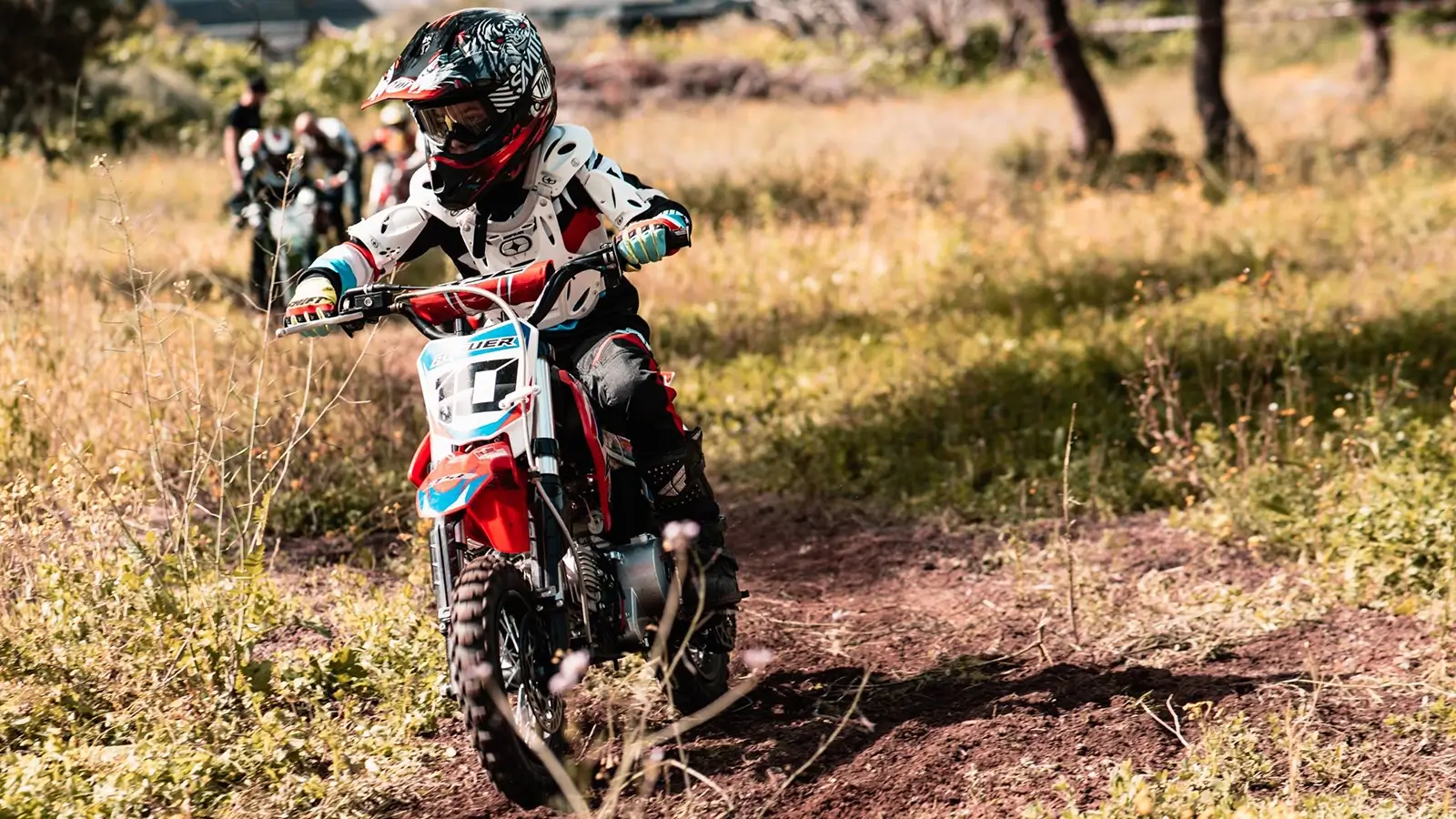
Key Takeaways
- Two numbers decide a child’s dirt bike, and they are wheel size and seat height, while engine capacity tells you the least about whether the machine fits.
- Seat height across our youth and smaller machines runs from 570 mm to 790 mm, and kerb mass runs from 46 kg to 75 kg.
- Our smallest machine, the KID 50, sits at 570 mm and weighs 46 kg, which is light enough for a young rider to manage on level ground.
- Age is a guide rather than a rule, because two children of the same age can differ greatly in reach, strength and judgement.
- In Australia, youth competition organisations set their own minimum ages, while public land access generally requires a rider licence, which in most states cannot be obtained before 16 years.
Parents shopping for a child’s dirt bike usually start with engine size, and that starting point produces the wrong machine more often than any other mistake in this category. The two figures that decide whether a child can ride a machine safely are wheel size and seat height, because the first determines how the bike crosses rough ground and the second decides whether the child can hold it at a standstill. Engine capacity describes how much power the machine has, and a child who cannot put a foot down gains nothing from having less of it. Therefore, the shopping order should be wheel size, then seat height, then weight, and only then engine capacity. We measured seat height and kerb mass across our youth and smaller machines, and the figures below come from those measurements.
One distinction applies throughout, and it concerns the difference between a machine that fits a child and a machine that a child can grow into. Those are not the same purchase, and confusing them costs more than it saves.
Two Numbers Decide It
Wheel size decides how a machine crosses an obstacle, and it matters more for a beginner than for anyone else. A smaller wheel meets a rock or a root almost square, which stops the machine and transmits the impact to the rider, while a larger wheel rolls over the same obstacle with far less disturbance. Consequently, a child learning on uneven ground benefits from a larger wheel, and a child riding a flat paddock gains little from it. In our experience, parents who look at wheel size before engine size choose a machine their child can actually ride, which is what makes the difference in the first season.
Seat height decides whether the child can hold the machine up, and that ability sets the pace of learning. A child who can put both feet near the ground will try new things, because a wobble is recoverable rather than frightening. A child who cannot reach the ground will avoid stopping on slopes, look down at the ground beside the bike and ride slower than their ability allows. Consequently, the machine sets the limit rather than the rider, which is the opposite of what a first bike should do. Therefore, a machine that is 20 mm too tall can cost a season of progress, which is a larger effect than any difference in engine output. In our experience, that single figure explains more first-year outcomes than the specification sheet does. Similarly, a 20 mm difference in seat height can be the difference between a child who rides every weekend and one who loses interest by the second month.
Kerb mass is the third figure, and it decides what happens after the inevitable fall. A machine that a child can lift is a machine a child can ride alone in a paddock, while a heavier machine requires an adult within reach at all times. Our youth machines weigh between 46 kg and 75 kg, and the difference between those two figures is the difference between a machine a strong ten-year-old can right and one that needs help. Consequently, weight belongs in the same conversation as seat height rather than in a separate one about performance. Our guide to choosing a machine by inseam covers the same measurement for adults.
The Seat Height Test
The seat height test takes two minutes and it produces a better answer than any published chart. Sit the child on the machine with an adult holding it upright, wearing the boots they will ride in, and check whether the balls of both feet reach the ground. Then ask the child to reach the handlebar, the brake lever and the gear lever without stretching or sliding forward on the seat. If both checks pass, the machine is a candidate, and if either one fails, the machine is too big regardless of anything else on the specification sheet.
The test needs to happen in riding boots rather than in everyday shoes, because the difference is larger than most parents expect. A dedicated riding boot has a stiffer sole and more protection than a trainer, and both features change the reach by an amount that matters on a 570 mm seat. In addition, the child should be able to hold the machine up without assistance, because a machine that requires a parent to keep it upright cannot be ridden confidently. Therefore, bring the boots to the dealership and perform the check there rather than at home after the purchase.
Two behaviours during the test tell you more than the measurements do, and both are worth watching. A child who puts a foot down instinctively and looks ahead is ready for the machine, while a child who grips the bars and looks at the front wheel is telling you the machine is at the edge of their comfort. In our experience, that second signal is easy to miss in the excitement of a showroom, and it is the one that predicts how often the machine will be used at home.
Measured Heights and Weights
Our youth and smaller machines cover 570 mm to 790 mm in seat height and 46 kg to 75 kg in kerb mass, which gives a parent a genuine range to choose within. The KID 50 sits at 570 mm and weighs 46 kg, and our pit bikes sit at 790 mm and 830 mm with a kerb mass of 75 kg. That spread means a family can match a machine to a small beginner and replace it later as the rider grows, rather than buying one machine that fits nobody well. Therefore, the range is a set of answers to different fit questions rather than a ranking of quality. For example, a family with an eight-year-old and a twelve-year-old can use two machines from the same range rather than forcing both riders onto one.
| Machine | Seat height | Kerb mass | Who it suits |
|---|---|---|---|
| KID 50 | 570 mm | 46 kg | A young beginner on level ground |
| PH02S | 590 mm | 59 kg | A slightly taller beginner |
| Pit bikes (PH05B, PH10L) | 790 mm to 830 mm | 75 kg | Older children and shorter adults |
| Full-size machines (reference) | 935 mm to 960 mm | 112 kg to 115 kg | Adults and tall teenagers |
Read that table with the weight column in mind, because the seat height and the mass move together. The 570 mm machine also weighs 46 kg, and the 960 mm machine weighs 115 kg, so a smaller machine is lighter as well as lower. Consequently, a child moving up a size gains stability on rough ground and loses the ability to lift the machine alone, and both changes arrive at the same time. In our experience, that trade is what makes the timing of an upgrade a real decision rather than an automatic step.
One figure we do not publish for our children’s electric machines is a seat height, and we are saying so rather than leaving it out. We have no verified figure, so we are not going to print one. Therefore, treat the physical check as the decision and any published number as background reading. In our experience, parents who perform the check in person rarely return a machine, while parents who order from a table often do.
Age Is a Guide, Not a Rule
Age is a guide rather than a rule, because two children of the same age can differ enormously in reach, strength and judgement. A tall, cautious nine-year-old and a small, fearless nine-year-old need different machines, and an age chart cannot distinguish between them. Consequently, the useful sequence is to establish the physical fit first and to use age only as a sanity check afterwards. Similarly, a rider who is tall for their age but light in build may fit a machine that their strength cannot manage, which is why the two checks belong together. In our experience, parents who do that end up with a machine the child rides often, and parents who shop by age end up with a machine the child grows into rather than one they use.
Australian safety regulation gives parents a useful category distinction, because the mandatory standard for quad bikes separates youth and transition machines from sports and general use machines on the basis of how they are marketed and used. That division reflects the same logic as fit: a machine built for a younger or less experienced rider is a different product rather than a smaller version of an adult one. In addition, the distinction gives parents a way to explain the purchase to a child who wants the machine their older sibling rides. Therefore, parents can use the category as a starting filter and then apply the physical check within it. Our article on where you can legally ride in Australia covers the land access side.
Competition introduces a second age framework, and it is separate from recreational riding. Motorcycling Australia issues competition licences through its own structure, and the Junior National licence is available from seven years of age while the Senior National licence starts at 16. That distinction matters because the two classes carry different requirements, including proof of age, proof of competency and current club membership. Consequently, a parent whose child wants to race should check the class rules before choosing a machine, because the two frameworks do not always point at the same size. In our experience, families who check both end up with one machine that serves both purposes rather than two.
When to Size Up
Sizing up should follow demonstrated control rather than a growth spurt, and three signals mark the moment. The rider can start and stop on command without hesitation, hold a line through a rut or a turn, and finish a session without the machine setting the pace. Until those are true, a larger machine adds risk rather than progression, because the rider will be managing the bike instead of learning on it. Therefore, keep the rider on the current machine until the skills arrive, and treat the upgrade as a reward for the skills rather than as a substitute for them. In addition, a rider who has never been outgrown by a machine trusts the process more, which makes the next step easier for everyone. Consider how quickly a child outgrows a machine they cannot control, because the answer is usually slower than a parent expects.
The second signal is physical and concerns recovery rather than riding, because the next machine will weigh more than the current one. A machine that a rider cannot lift alone turns every fall into a wait for help, which changes where and how that rider can safely ride. Our range reaches 122 kg at the top end, which most young riders cannot right without assistance. Consequently, work out who will be present when the machine falls, and size the machine for that person as well as for the rider.
Two practical points make the upgrade cheaper and safer, and both relate to timing rather than to money. Move up at the end of a season rather than in the middle, because a mid-season change costs the rider the progress they built on the smaller machine. Then keep the smaller machine if a younger sibling will use it, because a machine that stays in the family serves two riders rather than one. In our experience, families who plan a two-step progression spend less overall than families who buy one machine too large and replace it early.
Safety Setup Before the First Ride
Safety setup before the first ride takes an hour and it prevents the incidents that end a season early. Gear comes first, because a helmet, eye protection, gloves, boots and long sleeves protect the rider in the fall that every beginner has eventually. Then set the controls, because lever positions and bar position are adjustable on most machines and a rider who has to reach for the brake will brake late. Finally, check the consumables, which means tyre pressures and chain tension set to the figures in the machine’s own specification sheet. That step takes ten minutes and it prevents the two failures that end a first ride, which are a slipping chain and an under-inflated front tyre.
Two habits make the first month easier for everyone, and both concern the conditions rather than the machine. Start on flat, open ground where an adult can walk alongside, because a rider who learns to stop and turn on level grass builds the habits that make everything else safe later. Then keep sessions short and end while the child still wants more, because a tired rider makes the mistakes that turn a good day into a long recovery. In our experience, parents who follow both habits report fewer falls and faster progress than parents who do not. However, both habits are harder to follow in the first week than they sound, because a new machine makes everyone want to ride for longer than planned.
Adults should also model the gear rule, because children copy what they see rather than what they are told. A parent who wears a helmet every time they ride establishes the expectation without a conversation, and the same applies to boots and gloves. Consequently, the cheapest safety intervention available to a family is the behaviour of the adult in front. In our experience, that single habit decides whether gear becomes a negotiation or a routine.
Frequently Asked Questions
What size dirt bike for a child?
Start with wheel size and seat height rather than engine size. Our youth and smaller machines run from 570 mm to 790 mm in seat height and 46 kg to 75 kg in kerb mass. Sit the child on the machine in riding boots with an adult holding it upright, and check that the balls of both feet reach the ground (BSE Motor, 2026).
How do I know if a dirt bike is too big for my child?
Two signs settle it. If the balls of both feet cannot reach the ground, the machine is too tall, and if the child has to reach or stretch for the controls, it is too long as well. A machine that an adult has to hold upright cannot be ridden confidently, so treat either sign as a reason to choose a smaller model.
What age can a child start riding a dirt bike?
Age is a guide rather than a rule, because children of the same age differ in reach, strength and judgement. Physical fit matters more, so check foot placement and control reach first. For competition, Motorcycling Australia issues a Junior National licence from seven years and a Senior National licence from 16, with class rules that apply at events rather than in a paddock.
Should a child’s first bike be electric or petrol?
Electric suits many first bikes because it is quiet, so the machine can be used near a house without disturbing anyone, and there is no exhaust near a small leg. Petrol suits families who ride long sessions or who already maintain petrol machines. Match the choice to where the machine will be used and how long a session lasts.
Do kids need a licence in Australia?
It depends on the land. Riding on private land with the owner’s consent is treated differently from riding on public land, and a rider licence is required for public land in most states. That licence cannot be obtained before 16 years of age anywhere in Australia, and some states set the threshold slightly later. Check the rule for the specific place you plan to ride before you buy (Motorcycling Australia, 2026).
Conclusion
Three ideas decide a child’s dirt bike. Start with wheel size and seat height, because those two figures decide whether the machine is safe on rough ground and holdable at a standstill. Use age as a sanity check rather than as a rule, since children of the same age differ greatly in reach and strength. Then size up on demonstrated control, and check the next machine’s weight against whoever will lift it.
Your next steps:
- Measure seat height and wheel size before looking at engine capacity.
- Perform the fit check in riding boots with an adult holding the machine.
- Check your state’s rules for the land you plan to ride.
- Buy the gear in the same purchase as the machine.
Continue Learning
- Choosing a dirt bike by inseamWhy height is a poor guide to fit.
- Where you can legally ride in AustraliaState rules and private land explained.
- Browse our dirt bike rangeYouth, pit and full-size models.
- Browse our electric dirt bikesQuiet machines with swappable packs.
Specs for the models this guide talks about
Figures below are taken from our own product documentation (BSE Motor, 2026).
BSE PH02S — 50cc kids starter
- Seat height 590 mm
- Kerb mass 59 kg
- Wheelbase 1,050 mm
- 1.8 kW at 7,000 rpm, semi-automatic
BSE KID — 60cc pit bike
- Seat height 570 mm
- Kerb mass 46 kg
- Wheelbase 920 mm
- 1.8 kW at 7,000 rpm, fully automatic
Find a first bike that fits
Seat heights from 570 mm and kerb masses from 46 kg, with every fit figure published.
View dirt bikes →References
- Product Safety Australia, ACCC. Quad bikes mandatory standard. Accessed September 2026 (Product Safety Australia, 2026).
- Queensland Government. Recreational vehicles: conditional registration. Accessed September 2026 (Queensland Government, 2026).
- Motorcycling Australia. Licences. Accessed September 2026 (Motorcycling Australia, 2026).
Seat height and kerb mass figures in this article were measured by our own engineering team on our own machines, so they are not independent laboratory results (BSE Motor, 2026). Competition age rules come from Motorcycling Australia. This article was written by Mojo and reviewed by our engineering team. You can read more about us on the site, or contact our team with questions about a specific model.